
Upper School at Northwest prompts students to broaden and deepen their worldview through rigorous interdisciplinary study, while grappling with complex issues to produce original and creative work.
One recent example is this afternoon's presentations by four Northwest seniors, all of who completed original and in-depth extra-curricular STEM research on their own time this past summer.
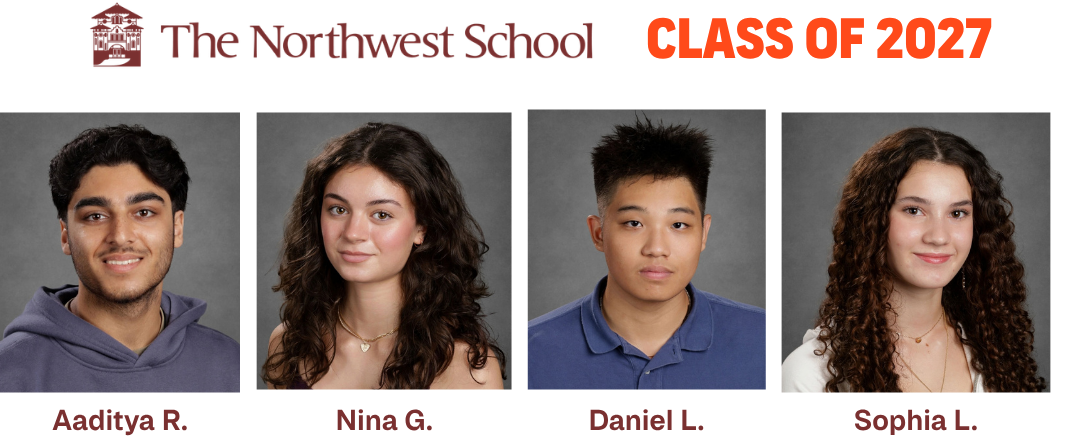
Daniel L., Sophia L. Aaditya R., and Nina G. all gave engaging TEDx-style presentations to their peers at today's grade-level meeting about original science projects that they completed across varied science topics.
Explaining why he chose to examine how social media affects our brains, Daniel L. (Class of '27) discussed how he took drastic measures to curb his doomscrolling. "I decided to used a phone cage – it literally uses a lock and key. And almost instantly, I felt my concentration came back, my anxiety went down, and I just felt better overall."
Job shadowing is so important. It gives you a front-row seat to whatever it is that you want to investigate.
This experience made him wonder how cellphones change our brains, and led him to delve into neuroscience and psychology. "I sourced and read academic research articles on Google Scholar, PubMed, and Research Gate, and finally put forward my own hypothesis in a 5,000 word essay," shares Daniel.
In a nutshell, he concluded that the neuropathway linked to trauma processing and recovery—such as in the case of PTSD—may also help explain the negative impact of social media on our brains.
Taking a different STEM trajectory, Aaditya R. (Class of '27) devoted his research experience and extra-curricular project to examining fluid mechanics, while Nina G. (Class of '27) conducted research on advances in the medical treatment of cleft palates.
Sophia L. (Class of '27) wanted a deeper understanding of a pre-existing topic of interest. "I've always been interested in reproductive and sexual health, and I have explored it through volunteering and activism," she says. "But I wanted to look at it through a medical lens and possibly a future career path."
So she opted to shadow Dr. Keemi Ereme, an OB-GYN at UW Harborview, and proactively reached out to state her in reproductive rights and intersectionality. "I mentioned that I was interested in the opportunity to shadow her," she finishes.
While Sophia did not did directly interact with patients, she worked closely under the doctor's supervision to get an in-depth sense of the work, including areas of gynecology, pregnancy, fertility care, breast and pelvic care. "I learned a lot about ultrasounds and measurements. And also this phenomenon called 'ferning," she explains, referencing a test for the presence of amniotic fluid that indicates the early stages of labor. "Under the microscope, it actually does resemble ferns."
One of her key takeaways was the importance of patient education. "Just being able to explain what is going on, help the patient understand what is happening, and help them feel comfortable to help build a healthy patient/doctor relationship."
In addition, shadowing enabled her to get firsthand expert input on how to get into the field. "My mentor was incredible," she exclaims. "I learned so much from her about her own career path and academic journey."
These students have modeled what we hope to inspire in all of our students: intellectual curiosity, initiative, and the belief that they can act independently to pursue passions. This is what it looks like to be life-long learners.
Longtime NWS faculty and current 12th Grade Level Coordinator Scott Davis encouraged and coached these students as they prepared their presentations. "This experimental, small-scale TEDx-style presentation is the product of a collaboration between several faculty members, including Danielle Thal (advising on the science), Kelly Marshall(championing the idea of a presentation), and myself (providing a venue and coaching the students)," he explains. "Personally, I am most impressed by how initial curiosities inspired these students to pursue new knowledge."
"There are many stages to the scientific method, but one of the most important is sharing our learning with others," says Danielle Thal, who teaches upper-level science courses at Northwest. "Professional scientists will do this in conferences and poster sessions. And our NWS student scientists got a taste by presenting their extracurricular research projects at a grade-level meeting."
Engaging in scientific research with a scientist mentor is an invaluable experience that helps students to gain authentic experiences to narrow down their future goals.
The scientific process allows these young scholars to delve deeper into areas of interest and passion. More importantly, the academic rigor involved in conducting and publishing original research can illuminate and help clarify potential career paths. And mentored research under a professional expert, in particular, provides important encouragement along the way.
"Engaging in scientific research with a scientist mentor is an invaluable experience that helps students to gain authentic experiences to narrow down their future goals," notes Thal. "While the work they do is very challenging, they learn how to work through problems and develop persistence."
Indeed, both Daniel and Sophia display a budding interest in pursuing scientific inquiry after Northwest. "I really enjoyed connecting different pieces of research together," says Daniel. "Asking small and simple questions about small things in your life – this is the basis of my curiosity. I would like to continue to do research, and maybe in neuroscience or neuropsychology."
Sophia echoes similar sentiments about her research project. "Shadowing is so important. It gives you a front-row seat to whatever you are interested in, helps you step outside your bubble, and gives you a clear image of what you want to do." She adds that this experience has fueled her interest in a public health career, "Possibly a pre-med track, pharmaceuticals, nursing, or human biology, but with a focus on women’s health."